Last Updated on 3 weeks ago by Supplement
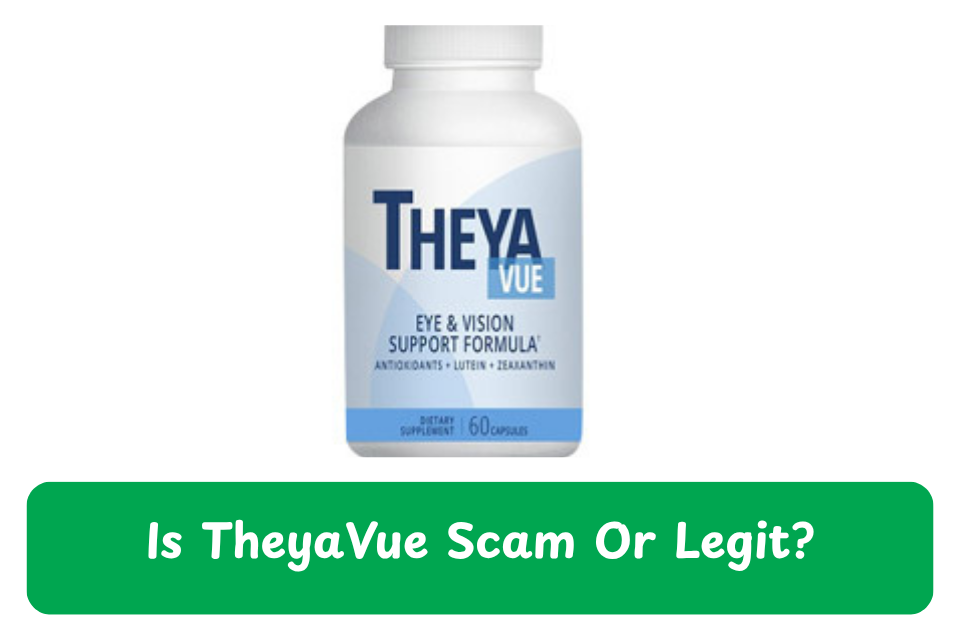
TheyaVue is marketed as a daily eye health supplement targeting age-related vision decline, dry eyes, blurry vision, and conditions including glaucoma, cataracts, and macular degeneration. It is distributed through ClickBank’s affiliate network, meaning independent websites earn commissions for promoting it. The product claims to contain either eight or twenty-four ingredients depending on which promotional page you read — an inconsistency the brand never addresses. No manufacturer name, no company registration, and no physical address for a responsible business entity appears anywhere on the product’s promotional materials; the only address found is a New York mailbox at 1732 1st Avenue, not a manufacturing facility. A “3-Second Rapid Finger Trick” featured in its promotional videos carries no published research of any kind. No clinical trial on the TheyaVue formula has been published, no doses are disclosed for any ingredient, and no verified buyer reviews exist on Trustpilot, the BBB, or Reddit from independent customers.
TheyaVue has recently gained attention in the health and wellness market, particularly for its claims to support eye health and improve vision clarity. With many products promising to enhance eyesight, it’s essential to question: Is TheyaVue a scam or a legitimate supplement? In this article, we will dive deep into the facts, ingredients, and real user experiences to help you determine if TheyaVue is a trustworthy product.
What is TheyaVue?
TheyaVue is marketed as a natural dietary supplement designed to support vision, protect eye health, and reduce the risk of age-related eye issues. According to its creators, TheyaVue contains a blend of natural ingredients, vitamins, and antioxidants that help defend the eyes from oxidative stress, improve visual sharpness, and promote overall eye wellness.
Does TheyaVue Really Work?
TheyaVue claims to provide several benefits to its users, including:
- Improved Vision Clarity: By nourishing the eyes with essential nutrients, TheyaVue aims to enhance focus and sharpness.
- Protection Against Age-Related Eye Issues: It is said to help reduce the risk of macular degeneration and other vision problems.
- Reduced Eye Strain: The supplement claims to relieve eye fatigue caused by prolonged screen exposure or reading.
The effectiveness of TheyaVue is largely due to its carefully selected ingredients, which have been shown to support eye health and reduce oxidative damage.
Key Ingredients in TheyaVue
TheyaVue’s formula includes several powerful ingredients known for their eye health benefits. Some of the most notable ingredients include:
- Lutein: A potent antioxidant that helps protect the eyes from harmful blue light exposure.
- Zeaxanthin: Works alongside lutein to improve visual performance and filter damaging light.
- Vitamin A: Essential for maintaining healthy vision and proper eye function.
- Bilberry Extract: Known for supporting night vision and protecting the retina.
- Zinc: Helps transport Vitamin A to the retina and supports overall eye health.
These ingredients have been scientifically studied and are commonly found in vision-support supplements due to their proven effectiveness.
Customer Reviews: What Are People Saying About TheyaVue?
User feedback is an essential factor in determining whether a supplement is legitimate or a scam. Here’s a look at some common customer sentiments:
✅ Sharper Vision: Many users report clearer and more focused vision after consistent use.
✅ Reduced Eye Fatigue: A significant number of users have claimed relief from digital eye strain.
✅ Positive Long-Term Benefits: Some customers have noticed gradual improvement in overall eye comfort and health.
However, it’s important to note that results can vary, and not all users experience immediate or dramatic changes.
Is TheyaVue a Scam or Legit?
Based on the scientifically backed ingredients, positive customer feedback, and transparency of the product, TheyaVue appears to be a legitimate supplement rather than a scam. It is sold through reputable sources, and there are no major red flags suggesting fraudulent activity.
Why TheyaVue Is Not a Scam
- Clear Ingredient List: The product clearly lists its ingredients, allowing customers to make informed decisions.
- Positive Customer Feedback: Many users report improved vision clarity and reduced eye strain.
- Scientific Support: The ingredients in TheyaVue are backed by research for eye health and protection.
Final Thoughts: Should You Try TheyaVue?
TheyaVue is not a scam—it is a legitimate supplement that offers potential benefits for supporting eye health, improving vision clarity, and reducing eye strain. While individual results may vary, many users have experienced clearer vision, less fatigue, and better eye comfort.
However, as with any supplement, it’s important to consult with a healthcare provider before starting, especially if you have pre-existing eye conditions.
Where to Buy TheyaVue
To ensure you receive a genuine product, purchase TheyaVue from its official website or trusted online retailers.
TheyaVue Review Analysis Summary
Our Rating: ★☆☆☆☆ 1.1/5
Summary
- ✗ TheyaVue promotional pages claim the supplement can “treat” glaucoma, cataracts, and macular degeneration — disease treatment claims that dietary supplements are prohibited from making under FDA regulations.
- ✗ The product claims to contain either 8 or 24 ingredients depending on the promotional source, with no doses disclosed for any of them.
- ✗ No manufacturer name or business address is disclosed; the address found on one page is a mailbox forwarding service in New York, not a manufacturing facility.
- ✗ A marketing feature called a “3-Second Rapid Finger Trick” is promoted without any published research or clinical basis.
- ✗ No verified buyer reviews were found on Trustpilot, Reddit, Amazon, Walmart, or the BBB.
⚠ Verdict: High Risk – Not Recommended
What Is TheyaVue?
TheyaVue is presented as a capsule supplement for eye and vision health, with two capsules taken daily with water. The promotional materials most consistently name eight ingredients: Lutein, Zeaxanthin, Bilberry extract, Rutin, Vitamin A (beta-carotene), Vitamin C, Vitamin E, and Zinc. Calcium also appears on some pages. However, a separate set of promotional materials describes the formula as containing “24 powerful antioxidants,” and no source reconciles these two counts or provides a complete unified ingredient list. No dose is disclosed for any ingredient on any publicly accessible promotional page. The product claims to address age-related macular degeneration (AMD), glaucoma, cataracts, dry eyes, and general eyestrain — conditions that are classified as diseases, and for which the FDA prohibits dietary supplement treatment claims. Pricing across promotional pages is presented as $59 for one bottle (60 capsules, 30-day supply), $49 per bottle for a three-pack, and $39 per bottle for a six-pack, alongside a reference price of $99 per bottle that is not sourced. A 60-day money-back guarantee is advertised, backed by ClickBank. No manufacturer name or business address is identified; the mailing contact found on one page is a New York mailbox address rather than the facility where the product is made.
Celebrity Endorsements and Testimonials
We examined all accessible TheyaVue promotional materials for celebrity endorsements, deepfake video content, and named medical professionals. We found no celebrity endorsement and no named ophthalmologist, optometrist, or vision specialist with a verifiable identity attached to the product. However, the promotional materials use several tactics that serve a similar function:
- “Doctor-recommended” and “scientifically backed” claims without sources: TheyaVue promotional pages describe the product as “doctor-recommended” and “scientifically backed.” No physician’s name, no clinical institution, and no peer-reviewed paper is cited in connection with these labels. These phrases appear as unsourced marketing assertions.
- Unverified research citations: Marketing materials reference a “2021 study” from a named journal and university. An analysis attempting to confirm this citation in August 2026 was unable to verify it. The citation cannot be independently located or confirmed.
- AREDS2 data misapplied to the product: Promotional pages cite the NIH-funded AREDS2 study on lutein and zeaxanthin to imply that TheyaVue has clinical support. AREDS2 studied specific doses (10 mg lutein, 2 mg zeaxanthin daily) of specific ingredients — not the TheyaVue formula at its undisclosed doses. Citing AREDS2 for TheyaVue does not transfer the study’s findings to this product.
- Positive user feedback with no platform attribution: Reviews describing “less eye strain after screen use,” “better night driving,” and “less need for reading glasses” are cited by affiliate review pages, but no neutral platform (Trustpilot, Amazon, Reddit) is named where these users can be found and verified.
If you encounter any advertisement placing a named doctor, celebrity, or public official behind TheyaVue, treat it as unauthorized and unverified unless a specific, confirmed, verifiable source can be provided.
Fake News Websites and Paid Coverage
All coverage of TheyaVue found during our investigation originates from affiliate-motivated sources, not independent editorial outlets. The distribution network includes:
- ClickBank affiliate network: TheyaVue is sold through ClickBank, a platform that manages affiliate commissions. Nearly every review page found carries a ClickBank affiliate disclosure or affiliate link, meaning the review author earns a commission on sales. This financial relationship is a material conflict of interest in any product evaluation.
- IPSNews.net and similar paid content platforms: Articles on IPSNews.net and local newspaper “marketplace” sections (including Langley Advance Times, Bellevue Reporter, and others) promote TheyaVue in editorial-style format. These are externally submitted sponsored or affiliate pieces, not independent journalism from those outlets’ own writers.
- Syndicated “Fake Websites Exposed” articles: Multiple near-identical articles titled “TheyaVue Reviews: Fake Vision Support Supplement Websites Exposed!” appeared across link-aggregator sites (letusbookmark.com, webnowmedia.com, bookmarkport.com, and others). These pieces simultaneously warn about fake TheyaVue websites while linking to ClickBank affiliate sales pages, a pattern associated with affiliate marketing rather than independent consumer protection.
- Jotform and experiment.com pages: TheyaVue promotional content appears on form-hosting sites and research-platform sites under paid or sponsored placement, further distributing the marketing message through non-editorial channels.
- Multiple third-party sales domains: At least one page directs buyers to sale365day.com rather than an official manufacturer domain, and another promotional page links through alternative-medicine.net. Multiple non-official domains handling product sales is a pattern associated with affiliate supplement marketing.
No independent editorial outlet — a consumer protection publication, an optics or ophthalmology journal, an investigative journalist, or a regulatory body — was found covering TheyaVue.
Claims vs. Reality: Does TheyaVue Really Work?
TheyaVue promotional materials make several specific and testable claims. None is supported by a clinical trial of the TheyaVue formula itself.
| Claims Made by TheyaVue | Reality Based on Investigation |
|---|---|
| Supplement can “treat,” “fix,” or address glaucoma, cataracts, and macular degeneration | Dietary supplements are prohibited by the FDA from claiming to treat, cure, or prevent any disease. Glaucoma, cataracts, and AMD are named diseases. These are not structure/function claims — they are disease claims. Making them in marketing materials exposes the seller to FDA and FTC enforcement action. |
| Formula is supported by a “2021 study” from a named journal and university | This citation could not be independently verified in an August 2026 review. A research citation that cannot be confirmed should not be relied upon as evidence of efficacy. |
| Lutein and zeaxanthin support is proven by the AREDS2 study | AREDS2 studied specific doses (10 mg lutein, 2 mg zeaxanthin) as part of a defined formulation. TheyaVue does not disclose its doses, so there is no basis for claiming AREDS2 findings apply to this product. |
| Formula contains 8 key ingredients AND contains 24 powerful antioxidants | These two claims appear on different promotional pages for the same product. The inconsistency is never reconciled. Buyers cannot know which count is accurate or what the additional undisclosed ingredients are. |
| Supplement is “100% safe” and causes “no side effects” | No supplement made of biologically active compounds can guarantee this. Bilberry interacts with blood thinners; high-dose zinc can deplete copper; vitamin A at high doses is teratogenic. Absolute safety claims are prohibited under FTC guidelines. |
| Made in an “FDA-approved, GMP-certified” facility | The FDA does not approve dietary supplement facilities the way it approves pharmaceutical plants. FDA facility registration is a baseline legal requirement, not a product quality endorsement. |
| Calcium is included as an ingredient that lowers AMD risk | One promotional page links to research under the description of calcium’s AMD benefits, but that link’s URL slug reads “high-calcium-increase-risk-of-amd,” suggesting the cited study actually shows the opposite of what the marketing claims. |
8 Red Flags in How TheyaVue Is Sold
Our investigation identified eight clear and verifiable red flags in how TheyaVue is marketed and sold. Each is based on what the official promotional materials and public sources show.
- Prohibited Disease Treatment Claims: Marketing pages state that TheyaVue can treat or fix glaucoma, cataracts, and macular degeneration. These are named diseases. Under 21 CFR 101.93 and FTC Act Section 5, dietary supplement marketers cannot make disease treatment claims. These claims expose buyers to the misunderstanding that a supplement can substitute for medically supervised treatment of serious, sight-threatening conditions — it cannot. People with these conditions need ophthalmic care from a licensed professional, not an anonymous online capsule.
- Inconsistent Ingredient Count: The same product is described as containing both 8 “key” ingredients and 24 “powerful antioxidants” on different official or affiliate promotional pages. This inconsistency is never explained. Buyers cannot determine what they are purchasing, since the same product should have one ingredient count, one Supplement Facts panel, and one label — none of which has been made publicly accessible.
- Zero Ingredient Doses Disclosed: Lutein and zeaxanthin — the two most credibly researched ingredients in the formula — have been studied for macular health at 10 mg and 2 mg per day respectively (AREDS2). Without knowing whether TheyaVue reaches these thresholds, no buyer can assess whether the product contains a therapeutically meaningful amount of anything. For zinc, which is also in the formula, the tolerable upper limit for adults is 40 mg/day; excess zinc interferes with copper absorption.
- No Manufacturer Name or Verifiable Address: The mailing address found on one promotional page — 1732 1st Avenue #28568, New York, NY 10128 — is a UPS Store mailbox address, not a manufacturing facility. No company name, business registration, or real physical address for the entity selling TheyaVue has been publicly disclosed. Buyers have no traceable legal entity to contact in a dispute.
- Unverifiable “Doctor-Recommended” and “Scientifically Backed” Claims: No named physician, no named research institution, and no peer-reviewed publication supports these phrases as used on TheyaVue promotional pages. Using these terms without substantiation is a deceptive marketing practice under FTC guidelines and has been the subject of enforcement actions against supplement companies.
- The “3-Second Rapid Finger Trick” Has No Published Research: The promotional video featuring a “3-Second Rapid Finger Trick” for vision improvement is a marketing device with no published study, no named researcher, no institution, and no clinical trial behind it. Hook-based marketing stories of this type are a documented pattern in supplement affiliate campaigns designed to create curiosity and urgency.
- Calcium Research Link Contradicts the Claim Made: A promotional page cites calcium as an ingredient that reduces AMD risk. The URL of the cited source contains the text “high-calcium-increase-risk-of-amd,” suggesting the linked study actually finds the opposite relationship. This indicates that marketing materials have been written without accurate engagement with the cited science, or that the citation was added without verifying what it says.
- ClickBank Affiliate Distribution Creates a Pervasive Conflict of Interest: Every independent-seeming review of TheyaVue found during this investigation includes a ClickBank affiliate link or commission disclosure. When every third-party “review” of a product is financially incentivized to recommend it, the review ecosystem provides no independent signal about the product’s real-world performance. Buyers searching for objective feedback encounter only commercially motivated content.
Is TheyaVue a Scam or Legit?
TheyaVue cannot be confirmed as a legitimate product based on available evidence. It makes prohibited disease treatment claims for serious, sight-threatening conditions. Its ingredient count is inconsistently reported across its own promotional ecosystem. No doses are disclosed. No manufacturer name or real business address has been found. All coverage traces back to ClickBank affiliates with a direct financial interest in promoting the product. The core ingredients — lutein, zeaxanthin, and bilberry — have real research relevance to eye health, but at specific doses that are not disclosed here, with efficacy claims tied to individual ingredients rather than to this formula at its undisclosed quantities. People with genuine vision concerns should see an ophthalmologist. Age-related macular degeneration, glaucoma, and cataracts are progressive conditions where delayed treatment can cause irreversible sight loss. No supplement should be used as a substitute for professional eye care, and a product making unsupported treatment claims for these conditions poses a specific and serious risk of delay in obtaining appropriate medical intervention.
What TheyaVue Lacks vs. What a Legit Product Should Have
The table below shows the most critical gaps in TheyaVue compared to what a credible eye health supplement should provide:
| TheyaVue | A Legit Eye Health Supplement |
|---|---|
| No manufacturer name, no business address — only a mailbox address | Named manufacturer with a verifiable physical address, business registration, and real customer service contact |
| 8 ingredients claimed on some pages, 24 on others — never reconciled | Consistent Supplement Facts panel published on the official site, identical across all promotional materials and the physical label |
| Zero ingredient doses disclosed | Full milligram amounts for every ingredient, ideally with a third-party certificate of analysis confirming label accuracy |
| Claims to treat glaucoma, cataracts, and AMD — FDA-prohibited disease treatment claims | Lawful structure/function claims only (e.g., “may support normal eye function”) — never disease treatment language |
| Unverifiable “2021 study” citation and AREDS2 misapplied to this product | Citations to studies that actually test the product formula at its actual doses, or clearly limited to individual ingredient research with transparent disclosure of their scope |
| No verified reviews on Trustpilot, Reddit, Amazon, Walmart, or the BBB | Verified reviews on neutral platforms with independently confirmed purchases |
| 60-day guarantee from an unidentified company with no verifiable address | Refund policy from a named, registered company with a verifiable return address and customer service phone number |
TheyaVue Complaints and Reviews
We searched Trustpilot, Reddit, the Better Business Bureau, Amazon, and Walmart for genuine TheyaVue buyer feedback. No verified independent reviews were found on any neutral platform. Here is what each source showed:
Trustpilot
Source: trustpilot.com
No Trustpilot profile was found for TheyaVue or for the gettheyavue.com domain. The search returned no brand page and no verified buyer reviews for this product on the platform.
Reddit
Source: reddit.com
No Reddit thread from genuine TheyaVue buyers was found. Search results for the product name on Reddit returned no substantive discussion. One of the strongest signals of a supplement’s real-world performance is organic Reddit discussion; its absence for TheyaVue is notable given the product’s promotional scale.
Better Business Bureau
Source: bbb.org
No BBB business profile or complaint record was found for TheyaVue or any named parent company. Without a BBB profile, there is no record of how the company handles consumer disputes and no publicly available complaint history.
Amazon and Walmart
Source: amazon.com, walmart.com
No official TheyaVue brand listing was found on either major retailer. All promotional materials describe the product as available exclusively through official affiliate channels and the brand website, which removes the independently enforced buyer review systems those retailers provide.
ClickBank Affiliate Review Sites
Source: affiliate pages (biopreneur.com.ng, bellevuereporter.com marketplace, langleyadvancetimes.com marketplace)
All available review material originates from ClickBank affiliates. These pages acknowledge financial conflicts of interest while describing the product positively. The feedback they cite — improved night driving, reduced screen strain, less need for reading glasses — comes from unnamed buyers on unnamed platforms and cannot be verified independently. One affiliate review notes “frustration over incomplete label transparency” and “mild stomach discomfort early on” among negative reports.
Vision deterioration, including AMD, glaucoma, and cataracts, is serious and potentially irreversible. A supplement claiming to address these conditions carries an elevated obligation to produce independently verified evidence. The complete absence of genuine buyer feedback on neutral platforms, combined with marketing language that makes prohibited disease treatment claims, means prospective buyers have no reliable basis for evaluating this product before spending up to $234.
TheyaVue Ingredients: Inside the Product
The most consistently cited ingredient list names eight compounds. The product also claims to contain sixteen additional unnamed “antioxidants” that are never identified in any public-facing document. No dose is disclosed for any ingredient.
- Lutein: A carotenoid concentrated in the macula of the eye. The AREDS2 study found that 10 mg/day of lutein, combined with 2 mg zeaxanthin, reduced the risk of AMD progression in people with intermediate AMD. The benefit is documented at a specific dose — and TheyaVue does not disclose how much lutein it contains, making it impossible to confirm the product reaches this level.
- Zeaxanthin: A carotenoid paired with lutein in macular protection research. The AREDS2 dose was 2 mg/day. As with lutein, the dose in TheyaVue is not disclosed.
- Bilberry extract: A European berry with anthocyanins studied for microcirculation in the eyes and for nighttime vision. Evidence is mixed; some studies show modest improvement in night vision, others find no significant effect. Bilberry has antiplatelet properties and may interact with blood thinners (warfarin, aspirin) at higher doses.
- Rutin: A flavonoid antioxidant. Some preclinical research suggests anti-inflammatory and capillary-strengthening effects in ocular tissue. Human clinical evidence for vision improvement is limited. Dose undisclosed.
- Vitamin A (beta-carotene): Beta-carotene is a precursor to vitamin A, which is essential for the production of rhodopsin — the photopigment in rod cells used for low-light vision. However, the original AREDS formula found that beta-carotene increased lung cancer risk in smokers, and AREDS2 replaced it with lutein and zeaxanthin for that reason. Beta-carotene supplementation may not be appropriate for current or former smokers. Dose undisclosed.
- Vitamin C: An antioxidant included in both original AREDS and AREDS2 formulas. Included in AREDS at 500 mg/day. TheyaVue’s dose is not disclosed.
- Vitamin E: Another antioxidant from the AREDS/AREDS2 formulas, included at 400 IU/day in AREDS. TheyaVue’s dose is not disclosed. High-dose vitamin E (above 400 IU/day) has been associated with increased hemorrhagic risk.
- Zinc: Included in the original AREDS formula at 80 mg/day, where it reduced AMD progression. However, AREDS2 lowered this to 25 mg/day because 80 mg was associated with hospitalizations for genitourinary conditions. The zinc dose in TheyaVue is not disclosed, which is a meaningful safety concern given the narrow range between beneficial and problematic doses.
- Calcium: Listed in some promotional materials but not in others. One page cites calcium as beneficial for AMD risk while the URL of its own cited source indicates the research shows calcium may increase AMD risk. The status of calcium in the formula is unclear and the cited supporting evidence appears to contradict the marketing claim.
TheyaVue Ratings
No verified independent ratings for TheyaVue were found on any neutral platform during our investigation.
| Website | Rating | Reliability |
|---|---|---|
| ClickBank affiliate review pages | Positive (no specific aggregate score found) | Unverifiable. All ratings come from financially motivated affiliate sources. No neutral platform ratings exist. |
| Trustpilot | No brand profile found | No data. No profile for TheyaVue or its associated domains was located. |
| Amazon | No official listing found | No data. Product is not sold through this retailer. |
| Walmart | No official listing found | No data. Product is not sold through this retailer. |
| BBB | No profile found | No data. No business record or complaint history surfaced. |
TheyaVue Scam Risk Score
TheyaVue was evaluated across five critical categories. The results indicate a high-risk purchase with significant regulatory compliance, transparency, and evidentiary problems in every area reviewed.
| Metric | Risk Score (0–10) | How We Rated It |
|---|---|---|
| Unverified Claims | 9/10 | Prohibited disease treatment claims for glaucoma, cataracts, and AMD; an unverifiable 2021 research citation; AREDS2 misapplied to an undisclosed-dose formula; “doctor-recommended” and “scientifically backed” without sources; and the “3-Second Rapid Finger Trick” with no published research behind it. |
| Ingredient Transparency | 8/10 | Inconsistent ingredient count (8 vs 24); zero doses disclosed for any ingredient; zinc and beta-carotene each present safety considerations at certain doses that cannot be evaluated without disclosure; calcium evidence cited in marketing appears to contradict the marketing claim. |
| Customer Complaints | 5/10 | No verified neutral-platform reviews found; however, ClickBank provides a dispute resolution channel that gives buyers more recourse than products with no identifiable payment processor. Partial credit for the ClickBank buyer protection mechanism. |
| Manufacturer Transparency | 8/10 | No company name, no real business address (mailbox only), no business registration. Contact information is an email and phone number only. Multiple non-official sales domains raise questions about accountability. |
| Marketing Honesty | 9/10 | Prohibited disease claims, absolute safety claims, “100% safe,” “doctor-recommended” without sources, unverifiable research, fake urgency language, a calcium citation that contradicts the marketing claim, and an affiliate-saturated review ecosystem where every third-party source earns a commission. |
| Overall Scam Risk Score | 7.8 / 10 | High Risk |
Fake and Lookalike TheyaVue Websites
TheyaVue’s distribution through ClickBank creates a network of affiliate domains that sell or promote the product without any official connection to a named manufacturer.
| Website Type | Warning Signs / Notes |
|---|---|
| sale365day.com (third-party sales domain) | At least one affiliate review page directs buyers to this domain rather than an official manufacturer site. Third-party sales domains for supplements are a risk factor: there is no guarantee the product sold there is authentic, and the buyer’s payment goes to an unnamed third party. |
| alternative-medicine.net (promotional affiliate domain) | Another promotional page routes buyers through this domain. Multiple non-official order paths for the same supplement increase the difficulty of identifying who received payment and who is responsible for the product. |
| Syndicated “Fake Websites Exposed” articles (letusbookmark.com, webnowmedia.com, and others) | These near-identical articles simultaneously warn about fake TheyaVue websites and link to ClickBank affiliate order pages — a pattern where the “consumer protection” article is itself a promotional vehicle. The article titles are designed to rank for “TheyaVue scam” searches while converting readers to buyers. |
| Local newspaper marketplace pages (Langley Advance Times, Bellevue Reporter) | TheyaVue promotional content appears under “spotlight” or “marketplace” URL paths on local news sites. These are externally submitted affiliate pieces, not editorial content by those organizations’ journalists. |
| gettheyavue.com (apparent brand domain) | The domain associated with the product’s support email address. No manufacturer is named on this domain and no Supplement Facts panel is publicly displayed, despite this being a regulatory requirement for supplements sold in the United States. |
How We Investigated TheyaVue
Our review of TheyaVue followed a structured, evidence-based process designed to separate verifiable facts from promotional claims. The steps included:
Identifying the Distribution Network: We searched for TheyaVue by name and identified ClickBank as the primary distribution mechanism, along with the affiliate review pages generated by that network. We confirmed that no independent editorial outlet covered the product.
Reading Promotional Materials: We reviewed multiple affiliate review pages, recording ingredient names, pricing, guarantee terms, company contact information, disease claims, and any citations given for clinical evidence. We noted the inconsistency between the 8-ingredient and 24-ingredient counts across different sources.
Searching for Customer Feedback: We searched Trustpilot, Reddit, the Better Business Bureau, Amazon, and Walmart for any buyer reviews or business records linked to TheyaVue. No neutral-platform buyer feedback was found on any service.
Checking Ingredient Science: We compared the named ingredients against published research, including AREDS and AREDS2, noting where the missing dose information prevents applying that research to this product.
Verifying Marketing Claims: We attempted to verify the “2021 study” citation used in TheyaVue marketing. We were unable to confirm the existence of the cited study. We also examined the calcium citation whose URL text contradicted the marketing claim it was cited to support.
Verifying Manufacturer Identity: We searched for a named company, physical business address, and business registration across all identified TheyaVue promotional materials. No named company or verifiable real address was found; the mailing address identified is a UPS Store mailbox service location.
How to Identify Risky Eye Health Supplements Like TheyaVue
Vision-related supplements are especially sensitive because the conditions they often invoke — macular degeneration, cataracts, glaucoma — are progressive diseases where delayed medical treatment can cause permanent, irreversible sight loss. These warning signs can help you evaluate an eye supplement before spending money on it:
Disease Treatment Language: Any supplement that claims to “treat,” “fix,” “reverse,” or “cure” a named eye disease (AMD, glaucoma, cataracts, diabetic retinopathy) is making a prohibited disease claim. Dietary supplements can support normal eye function; they cannot treat diagnosed diseases. This language is not just a red flag for scam risk — it is a sign that the company is either unaware of or disregarding FDA regulations, which is a reason not to trust its safety and quality processes.
AREDS/AREDS2 Citation Without Dose Matching: The AREDS2 study is the most cited clinical evidence in eye supplement marketing, and its findings for lutein and zeaxanthin are legitimate. However, those findings apply specifically to 10 mg lutein and 2 mg zeaxanthin daily as part of an evaluated formulation. A supplement that invokes AREDS2 but does not disclose its doses cannot claim AREDS2 support — the relevant question is always whether the product reaches the studied dose, not just whether it contains the studied ingredients.
Inconsistent Ingredient Counts: When a product claims different numbers of ingredients on different pages — 8 in one place, 24 in another — without ever providing a consistent Supplement Facts panel, the company either has no quality control over its own marketing claims or is deliberately obscuring what the product contains. Either interpretation is a disqualifying problem for a supplement you are considering taking daily.
No Manufacturer Transparency: A mailbox address is not a manufacturer address. A real supplement manufacturer maintains a facility with a registered address, manufacturing licenses, and GMP documentation. When the only address available is a mail forwarding service, there is no way to verify where the product is made, who makes it, or whether the facility it is made in has ever been inspected.
TheyaVue Side Effects
Because no ingredient doses are disclosed, a complete safety assessment for TheyaVue is not possible. Based on the named ingredients, the following risks are documented in published research:
- Beta-carotene and smoking: The ATBC and CARET studies found that beta-carotene supplementation increased lung cancer incidence and mortality in current and former smokers. This is a well-established finding that led to the removal of beta-carotene from the AREDS2 formula. Smokers and former smokers should not take beta-carotene supplements. TheyaVue’s beta-carotene dose is not disclosed.
- Zinc toxicity: The original AREDS formula used 80 mg zinc/day, which was associated with hospitalization for genitourinary conditions; AREDS2 reduced this to 25 mg. The tolerable upper limit for adults is 40 mg/day. Long-term zinc supplementation above 40 mg/day depletes copper, potentially causing anemia and neurological symptoms. TheyaVue’s zinc dose is undisclosed.
- Vitamin E at high doses: Doses above 400 IU/day have been associated with increased all-cause mortality in some meta-analyses and with increased hemorrhagic risk. Dose in TheyaVue undisclosed.
- Bilberry and blood thinners: Bilberry’s antiplatelet properties can amplify the effect of warfarin, aspirin, clopidogrel, and other anticoagulants, increasing bleeding risk. People on anticoagulant therapy should not take bilberry without physician supervision.
- Mild stomach discomfort: Some affiliate review feedback mentions early-use stomach discomfort, which is consistent with multi-ingredient supplement formulas.
- Pregnant women and anyone taking prescription medications, particularly blood thinners, beta-carotene–interacting drugs, or mineral-absorption–affecting medications, should consult a physician before taking TheyaVue.
TheyaVue Refund Process
TheyaVue advertises a 60-day money-back guarantee, backed by ClickBank’s buyer protection policy. To protect your purchase if you have already bought TheyaVue:
- Save your full ClickBank order confirmation, the exact domain you purchased from, and your complete payment receipt before initiating any contact.
- If the seller does not respond within 7 to 10 business days, contact ClickBank directly at clkbank.com, since ClickBank provides an independent buyer dispute mechanism that is more likely to be responsive than the seller’s own support.
- Note the return address found on at least one promotional page: 19655 E 35th Dr, Suite 100, Aurora, CO 80011 — but confirm the current return address with support before shipping anything back, as third-party fulfillment addresses can change.
- Request a return merchandise authorization number in writing before sending any product, and keep the tracking number from your return shipment.
- If all other channels fail, contact your card issuer to file a chargeback within your card’s dispute window, citing the written guarantee as your basis.
- Report unresolved complaints to the FTC at reportfraud.ftc.gov and to the FDA’s MedWatch system if you experienced any adverse health effect from the product.
Final Verdict: Is TheyaVue Worth It?
No, TheyaVue is not worth the risk at $59 to $234 per order. The product makes prohibited disease treatment claims for serious, sight-threatening conditions — glaucoma, cataracts, and macular degeneration — that require professional medical management, not a supplement from an anonymous source. Its ingredient count is inconsistently reported, no doses are disclosed, the only address found is a mailbox, and no clinical trial of the TheyaVue formula has been published. The research citations it uses are either unverifiable or misapplied. The review ecosystem is composed entirely of ClickBank affiliates with a direct financial interest in recommending the product. The core ingredients — lutein, zeaxanthin, and bilberry — have legitimate research support for eye health at specific documented doses, but that research does not transfer to an undisclosed-dose product marketed through disease claims and unsourced authority. People experiencing vision changes or diagnosed with AMD, glaucoma, or cataracts need to see an ophthalmologist — not spend $234 on unlabeled capsules from an unidentified manufacturer.
Frequently Asked Questions (FAQ)
What is TheyaVue used for?
TheyaVue is marketed for age-related vision decline, dry eyes, eyestrain, and also makes claims about treating glaucoma, cataracts, and macular degeneration. These disease treatment claims are prohibited for dietary supplements by the FDA. Any of these conditions requires professional diagnosis and treatment by an eye care specialist, not a supplement.
What are the ingredients in TheyaVue?
The most consistently cited list names Lutein, Zeaxanthin, Bilberry extract, Rutin, Vitamin A (beta-carotene), Vitamin C, Vitamin E, Zinc, and Calcium. Some promotional pages claim the total is 24 ingredients; others say 8. No doses are disclosed for any ingredient, and the full ingredient list is never publicly identified in one place.
Who makes TheyaVue?
No manufacturer name or company is disclosed. The mailing address on one promotional page is a UPS Store mailbox service in New York, not a manufacturing facility. The product is sold through ClickBank’s affiliate network. Contact: support@gettheyavue.com, 1-800-390-6035.
Does TheyaVue work for macular degeneration?
No clinical trial of TheyaVue has been published. The product invokes the AREDS2 study to imply clinical support, but AREDS2 found benefits at specific doses (10 mg lutein, 2 mg zeaxanthin) — and TheyaVue discloses no doses. AMD management requires medical supervision by an ophthalmologist; no supplement can replace this.
Is TheyaVue FDA approved?
No. Dietary supplements are not FDA-approved before sale. The FDA also does not approve dietary supplement facilities the way it approves pharmaceutical plants. Claims of “FDA-approved facility” are a common misuse of FDA terminology in supplement marketing.
Are there real customer reviews for TheyaVue?
No verified independent reviews were found on Trustpilot, Reddit, the BBB, Amazon, or Walmart. All available reviews come from ClickBank affiliate pages where the reviewer earns a commission on sales. This is a pervasive conflict of interest that makes the reviews unreliable as independent assessments.
Is there a refund for TheyaVue?
A 60-day money-back guarantee is advertised. It is backed by ClickBank’s buyer protection, which provides more recourse than products with no identifiable payment processor. If the seller does not respond, contact ClickBank directly at clkbank.com before your dispute window expires.
What are the side effects of TheyaVue?
Beta-carotene increases lung cancer risk in smokers and former smokers — a serious, well-established finding. Zinc at high doses depletes copper. Bilberry may interact with blood thinners. High-dose vitamin E has been associated with increased bleeding risk. None of these doses is disclosed, making safety assessment impossible.
Is TheyaVue safe for people on blood thinners?
Bilberry, which is in the formula, has antiplatelet properties that can amplify anticoagulant medications. People on warfarin, aspirin, clopidogrel, or other blood thinners should not take TheyaVue without first consulting a physician. The undisclosed bilberry dose makes the degree of interaction impossible to assess in advance.
How can I tell if an eye supplement is legitimate?
A credible eye supplement discloses the manufacturer’s name and address, provides a complete Supplement Facts panel with all ingredient doses, references clinical evidence accurately with doses that match the product, has verifiable buyer reviews on neutral platforms, and does not make disease treatment claims. Lutein and zeaxanthin in particular should carry disclosed doses so you can compare them against the AREDS2 benchmark. Any product missing these basics warrants caution before purchase.